So hopefully my MC will sampai to the Ogre and to the HR office and hopefully nada papa happen again not like during my 1st trimester which sucks and yes full of stress. I was hoping to have an assistant / partner in stroke centre since I can’t move that fast anymore. But NO they said I DON’T NEED any HELP pasal my place nda sibuk. Inda sibuk my ASS. Its better to have a backup before its too late. So now I’m away for a week now they will think who is gonna replace me. Nah Nah Nah~~ well 1st thing I gotta do is to send text msg to the Ogre telling that i’m away for a week. Then double check with Chief Kadam if my MC had forwarded to the HR people or not.
Doctor C also advised me to lay on my left side which I don’t really like because I don’t feel comfortable but now I have to force myself to sleep on the left side instead of right. And yes drink more fluids like WATER..hehehe that of course aku jarang minum time kaja. Because tired of going back and forth to the toilet. So yeah left side it is..
Hopefully everything starts tomorrow will be ok. Amin mudahan2 tah semua jalan dgn lancar…
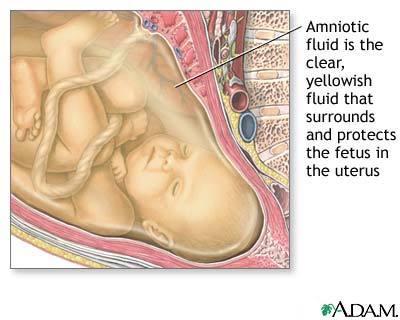
Here are some infos regarding Amniotic Fluid a.k.a air tetuban nya org melayu lurus kah nda jua tu hehehe
Functions of amniotic fluid
Amniotic fluid is “inhaled” and “exhaled” by the fetus. It is essential that fluid be breathed into the lungs in order for them to develop normally. Swallowed amniotic fluid also creates urine and contributes to the formation of meconium. Amniotic fluid also protects the developing baby by cushioning against blows to the mother’s abdomen, allows for easier fetal movement, promotes muscular/skeletal development, and helps protect the fetus from heat loss.
Analysis of amniotic fluid, drawn out of the mother’s abdomen in an amniocentesis procedure, can reveal many aspects of the baby’s genetic health. This is because the fluid also contains fetal cells, which can be examined for genetic defects.
Complications related to amniotic fluid
Too little amniotic fluid (Oligohydramnios) or too much (Polyhydramnios or Hydramnios) can be a cause or an indicator of problems for the mother and baby. In both cases the majority of pregnancies proceed normally and the baby is born healthy, but this isn’t always the case. Babies with too little amniotic fluid can develop contractures of the limbs, clubbing of the feet and hands, and also develop a life threatening condition called hypoplastic lungs. If a baby is born with hypoplastic lungs, which are small underdeveloped lungs, this condition is potentially fatal and the baby can die shortly after birth.
On every prenatal visit, the obstetrician/gynaecologist or midwife should measure the patient’s fundal height with a tape measure. It is important that the fundal height be measured and properly recorded to ensure proper fetal growth and the increasing development of amniotic fluid. The obstetrician/gynaecologist should also routinely ultrasound the patient—this procedure will also give an indication of proper fetal growth and amniotic fluid development. Oligohydramnios can be caused by infection, kidney dysfunction or malformation (since much of the late amniotic fluid volume is urine), procedures such as chorionic villus sampling (CVS), and preterm premature rupture of membranes (PPROM).
Oligohydramnios can sometimes be treated with bed rest, oral and intravenous hydration, antibiotics, steroids, and amnioinfusion.[citation needed] It is also important to keep the baby warm.
Polyhydramnios is a predisposing risk factor for cord prolapse and is sometimes a side effect of a macrosomic pregnancy. Hydramnios is associated with esophageal atresia. Amniotic fluid is primarily produced by the mother until 16 weeks of gestation.
Preterm premature rupture of membranes (PPROM) is a condition where the amniotic sac leaks fluid before 38 weeks of gestation. This can be caused by a bacterial infection or by a defect in the structure of the amniotic sac, uterus, or cervix. In some cases, the leak can spontaneously heal, but in most cases of PPROM, labor begins within 48 hours of membrane rupture. When this occurs, it is necessary that the mother receive treatment to avoid possible infection in the newborn.
Color of the amniotic fluid, with possible meanings:
* GREEN - Meconial amniotic fluid.
* YELLOW - Hemolytic disease.
* BROWN - Infection.

No comments:
Post a Comment